
 Second part of the article on the principle of capacity control and its benefits in the search for energy saving.
by Alonso Amor*
In the first part we met different capacity control points: variable capacity compressors, Frequency inverter control and digital technology control. We continue now with other viable options of these tools that allow remarkable energy savings.
Electronic expansion valves: Electronic expansion valves have emerged as an alternative to technologies previously used in order to have a more precise control of overheating as well as a greater modulation capacity. Driven by step motors or pulse technology, the electronic expansion valves work according to the signal coming from a controller, which by means of a pressure transducer and a temperature sensor, performs the instantaneous calculation of the overheating allowing a modulation of the coolant flow according to the current need of the system.
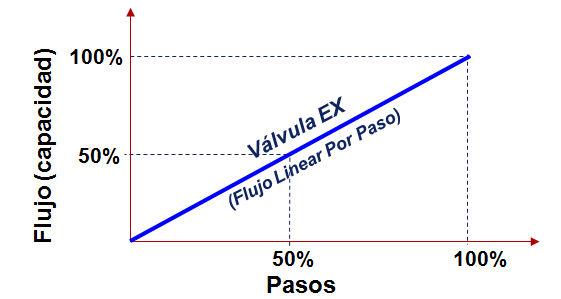
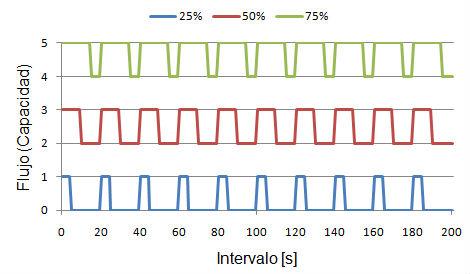
Step motor expansion valves offer more precise overheating control than pulse-driven valves, as the different motor positions allow linear power control (see graph 3). Pulse control valves base their operation on the total opening of the valve port for different time intervals (see graph 4) which generates a certain imprecision in the control of overheating.
If there is any error in the calculation of evaporators or pipes for the specific application, the expansion valves by pulse control may even generate rupture of the pipe by water hammer generating serious losses to the system. An advantage of pulse valves is the fact that they operate as a normally closed solenoid valve to control the flow, which in the event of a failure in the electrical system will remain closed and prevent the migration of refrigerant liquid to the compressor. Already in the case of step engine valves an additional solenoid valve must be incorporated into the liquid line.
Graph 3: Step Motor Control
Graph 4: Pulse Control
Several studies have shown the energy advantages of the use of electronic expansion valves, the results vary depending on the component used, application and location, being that in all cases important energy benefits and short return on investment times are obtained.
There are four main reasons why electronic expansion valves have competitive advantages over thermostatic expansion:
1. Overheating adjustability
2. Range of application
3. Working in the presence of flash gas
4. Compressor safety
The main factor that leads valves to be able to offer these advantages is the ability to work in a much more extensive amplitude than a thermostatic expansion valve. An electronic expansion valve can work completely closed (preventing the flow of the refrigerant) or fully open giving the maximum of its design capacity, on the other hand, a thermostatic expansion valve only has a small adjustment range that allows it to vary the flow of refrigerant and does not have the ability to close completely.
It is precisely the control of this point of operation that will make the application more efficient with this new technology, being that the variable adjustment of the position of the valve can also cause different control strategies in other components of the system.
Floating suction
Floating suction is a control principle that bases its operation on the reduction of the compression ratio, this is achieved by gradually increasing the suction pressure to the point that it allows to guarantee the desired temperature in the cooled space.
Unlike other methods, floating suction is a solution whose installation is inexpensive because it only depends on an algorithm that is normally already part of the programming of the controller used for the modulation of compressors.
The floating suction often also used as a "night setpoint" which consists of raising the temperature of the refrigerated spaces during the hours of low need for cold or closure of the establishment.
For the application of this method it is necessary to have a fine control of the compression stage because a change in the setpoint of the suction pressure will generate less demand in the compressors and this should not cause an imbalance of the system.
Floating suction cannot be used in all cases, it is mainly discarded when in addition to temperature control it is sought to obtain a control of the relative humidity of the room. This is because the change in the suction pressure generates an adjustment of the evaporation temperature differential modifying the psychometric conditions.
Fan Speed Control
Speed modulation in evaporator and condenser fans can be performed for different purposes depending on the application. Normally, this type of control is used to maintain a constant condensation pressure or to regulate the air flow in products that require it in the case of the evaporator.
There are several methods to vary the speed of the motors however the two most used technologies are the use of frequency inverters or the installation of electronically switched motors (EC). In both cases, an analog signal from a controller is required.
- Speed control in evaporator motors. The variation of the speed of the evaporator motors occurs mainly in applications that due to the nature of the product or process should not have 100% of the air flow in some previously established periods. A typical example of this is the cooling of beef channels where at the beginning of the process a large volume of air is required to quickly cool the product, however at the end of the process, an excess of ventilation will generate a decrease in the product in water. Speed control in evaporators is also used in applications with temperature and humidity control.
Whenever the fan speed of the evaporator is varied, it will have an impact on the suction pressure. A decrease in speed will result in a lower suction pressure due to the lower heat exchange in this new rotation. The evaporator's fan speed control is directly linked to the overheating control. At low speeds there must be a lower supply of liquid to the evaporator, because there will not be enough heat exchange to evaporate the flow of refrigerant that was working at higher revolutions. Whenever you have this type of control, the use of electronic expansion valves is recommended, because depending on the application and speed variation, a thermostatic expansion valve will not have the ability to keep the system with a correct overheating adjustment in the entire required capacity range.
- Speed control in capacitor motors. The selection of equipment for a cooling system is made with two references: A constant thermal load and a fixed operating condition, being the responsibility of the project manager to have the ability to identify that this condition and loads are the most suitable for the application. However a reference is taken, it is known that there will be variables that will make the equipment and application work in various conditions. Undoubtedly, one of the factors that will change the most will be the ambient operating temperature and with it the discharge pressure and this must be controlled in order to have a correct operation of the equipment. One of the ways to achieve this in air-cooled capacitors is speed control in condenser motors.
The speed modulation of the condenser fans has emerged as an improvement to the method called "fan cycling" which consists of turning on and off the different motors of the capacitor.
With the variation of the speed, unlike fan cycling, a linear control of the discharge pressure is obtained since this method is not based on fixed stages of capacity but on a signal that can go from 0 to 100%. In addition, with speed control, as analyzed in the case of compressors, electrical energy is reduced to the cube of capacity (see graph 5).
Figure 5: Capacity Control for 6 Motor Capacitor
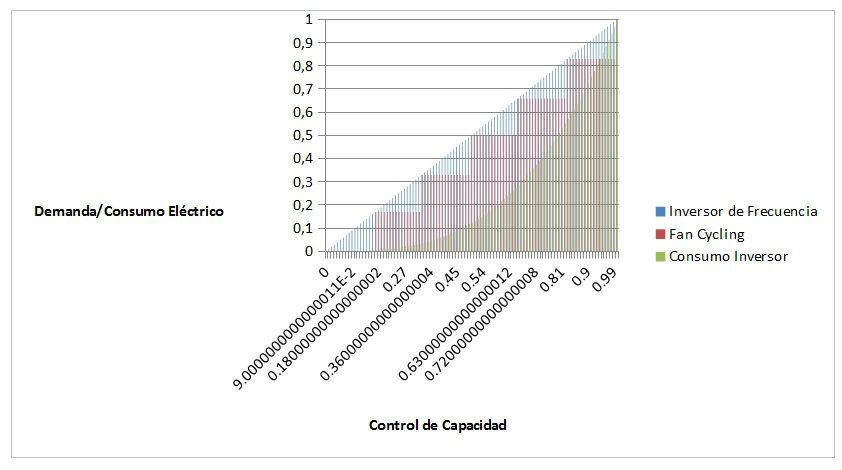
The discharge pressure varies mainly for two reasons: outside ambient temperature and the capacity control of the compression stage. Given a higher ambient temperature, the heat exchange that can be carried out in the condenser coil will be lower and therefore a greater air flow is required to maintain the discharge pressure at the desired point. The speed must also be regulated to prevent the pressure from going below the desired values because this can cause you not to have enough differential pressure for the expansion valve to work correctly. It is also understood that the condenser area is fixed and that the compressors will work according to instantaneous demand so it is necessary to vary the air flow to adjust to the current capacity of the compressors.
Conclusions
Capacity control systems are a necessary tool to ensure the correct operation of the cooling system. They also represent the right means to obtain a stable temperature with the lowest possible operating cost.
Since the system works together, it is important to emphasize that the application of some method of capacity control will lead us to the installation of another as a consequence, for example controlling the capacity of the compression stage will necessarily need control the condensation stage, and using similar technologies will lead the refrigeration system to an integral solution and with answers according to instantaneous demand.
It is the responsibility of the designer to select the control method that best suits the specific application and sufficient time should be spent in the field to make the relevant adjustments.
References
- F.J. Elrich, Blocked Suction Unloading Improves Part Load Efficiency of Semi-Hermetic Reciprocating Compressors, 1984, International Compressor Engineering Conference, Paper 434.
- Emerson Climate Technologies, Digital Capacity Control for Copeland Scroll Refrigeration Compressors, 2013, AE21-1319 R6
- Emerson Climate Technologies, Use of Variable Frequency Drives With Copeland Scroll and Discus Compressors, 2011, AE21-1369 R1
* Eng. Alonso Amor. Technical Manager Flow Controls Latin America. Emerson Climate Technologies. Guadalajara, Jalisco, Mexico. [email protected]