

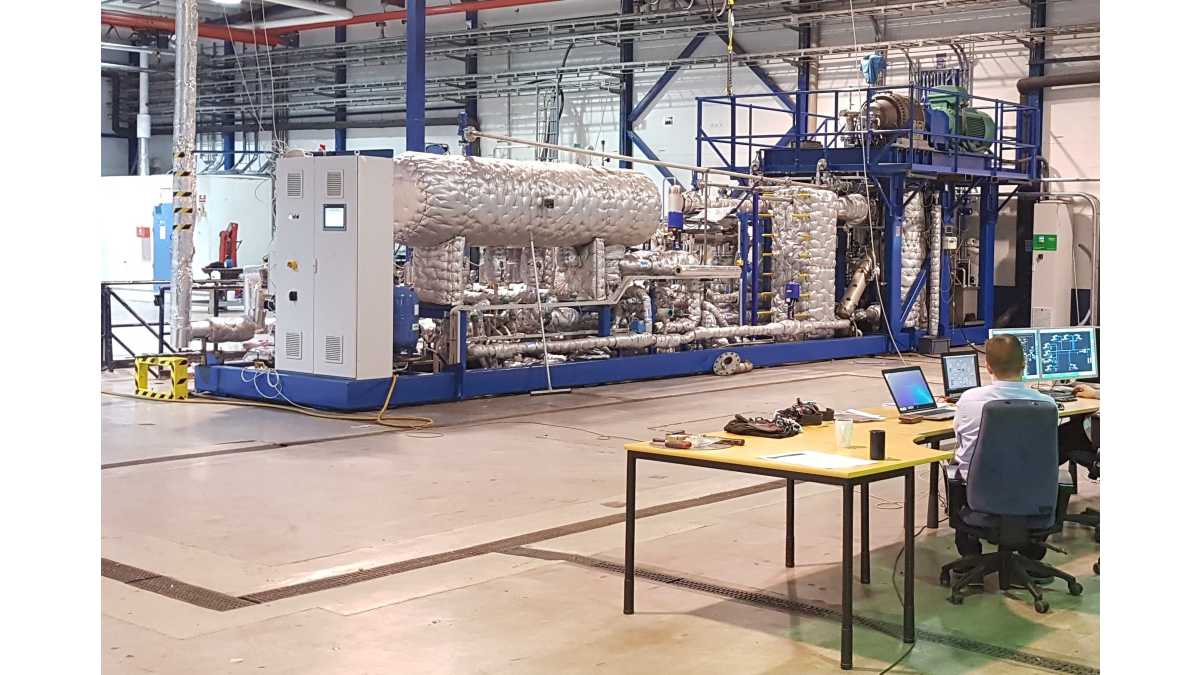
 International. Researchers working with industrial partners have developed the world's first heat pump that produces temperatures of up to 180 degrees Celsius. These record temperatures will allow a fifth of European industry to reduce its energy consumption by up to 70 percent and become completely climate neutral.
Heat pumps used to heat homes and domestic water operate at temperatures between 30 and 60 degrees, but many industrial processes require much higher temperatures, and some industries require completely different technology.
The industries, in collaboration with their research partners, have recently developed the world's first heat pump that can produce process heat at temperatures up to 180 degrees.
"This new heat pump delivers exactly what they want, so it has great commercial potential," says SINTEF researcher Michael Bantle. "This will be a ripe fruit for industries that aim to reduce both greenhouse gas emissions and energy consumption," he says.
Industries that will benefit from heat pumps operating at these temperatures include the food, fisheries and aquaculture, paper, oil and gas and metallurgy sectors.
The world's first zero-emission dairy
The new heat pump represents the advancement of a technology initially developed for dairy processing at TINE, in the Norwegian city of Bergen, and enabled the company to become the world's first dairy with zero emissions. It was the first to use only heat pumps for industrial heating of these products and in a temperature range of 100 ° C.
"The project demonstrated how profitability can be achieved using green industrial processes," says Bantle. "The heat pump allowed us to eliminate greenhouse gas emissions and save primary energy at the same time. Primary energy is that which is introduced into the installation from external sources," he says.
TINE achieves this by improving its excess heat to process the heat temperature with a series of heat pumps and thermal storages, thus reducing its total energy consumption by up to 50 percent.
Temperatures above 100 degrees are not normally required in the dairy sector and can be generated using ammonia and water as a working medium.
"This mixture is a well-known cooling agent, suitable for working temperatures between 50 and 120 degrees," adds Bantle.
Since their success at TINE, researchers have been studying how it might be possible to produce even higher temperatures using a heat pump concept that also uses a climate-friendly cooling agent.
"To reach temperatures of up to 180 degrees, we had to identify a cooling agent with somewhat different thermal properties, and finally we ended up with the most natural of all: water," bantle says.
Combine two machines into one
The project is a collaborative effort between SINTEF, NTNU and Norwegian compressor manufacturer Tocircle. Together they have developed a heat pump that combines SINTEF's extensive R&D experience in the field of water and steam technology, with a rotary vane machine specially designed and built by Tocircle.
"The vane machine is a type of compressor equipped with vanes that rotates in such a way that the volume of the compressor changes with each revolution," explains Bantle. "The secret of the Tocircle compressor is that all its moving parts that are in contact with the working medium are lubricated with water," he says.
The use of injected water in connection with steam compression not only promotes lubrication, but also reduces thermal stress on the system. Without the water, there is a danger of overheating the compressor while compressing.
"All these factors combined in a single machine offer a very promising platform for the development of a high-temperature heat pump with pure water as a working medium, and especially since many industrial processes already use steam as an energy carrier in the first place," explains Bantle.
No heat waste
The researchers anticipate that the new heat pump technology will enable reductions in industrial energy consumption of between 40 and 70 percent, facilitated by the recovery of waste heat at low temperature. Consequently, this will reduce the need to use gas or electric boilers.
"This means we don't have to waste heat anymore, but we can keep the heat we generate for ourselves," Bantle says. "This in turn will drastically reduce our greenhouse gas emissions because it will be possible to retain the excess heat generated by the industrial process, feed it to the heat pump and thus increase the temperature of the process," he says.
"Investing in a heat pump costs money, but this technology will guarantee great savings that will allow us to recover our investment costs relatively quickly," adds Bantle.
Zero greenhouse gas emissions
"Since we have excellent access to clean energy here in Norway, there will be no greenhouse gas emissions from the use of this heat pump technology," bantle says.
The technology is expected to be launched on the market during 2021.
Source: Sintef.