
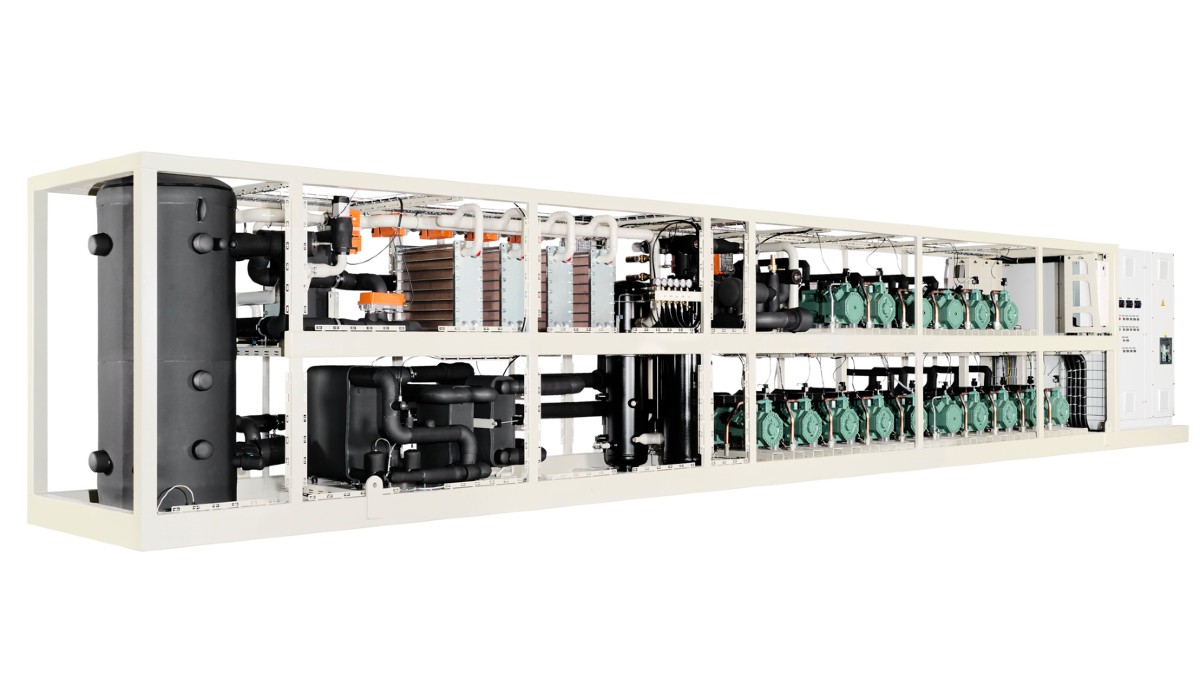
International. Advansor announced the launch of its new SteelXL heat pumps, a high-capacity solution designed to supply up to 50 MW of sustainable heating in industrial, commercial and district heating applications.
The new units set a benchmark in the large-scale HVAC segment, offering up to 5 MW of heating and 3 MW of cooling per equipment. In addition, they allow parallel configurations that reach up to 50 MW of total capacity, adapting to projects that demand high levels of power and operational flexibility.
One of the main differentials of the SteelXL series is the use of CO₂ as a natural refrigerant, which guarantees a safe, non-toxic and non-flammable operation, while facilitating compliance with European regulations on fluorinated gases. These heat pumps can reach water outlet temperatures of up to 95°C, with a profile of +60/+95°C, allowing them to be integrated into existing systems and used as a direct replacement for fossil fuel boilers.
In terms of efficiency, the units achieve a coefficient of performance (COP) of up to 4. They incorporate advanced technologies such as ejectors, permanent magnet motors and variable frequency drives, aimed at reducing energy consumption and emissions. In addition, all equipment is CE certified, factory tested and pre-programmed controllers that simplify commissioning.
The company's own control system optimizes operation under different operating conditions, while the master-slave functionality facilitates the integration of multiple units in parallel without affecting installation times.
Designed to streamline deployment processes, the SteelXL includes standardized controllers for heat pump applications, eliminating the need for additional control systems. Integration using the MODBUS protocol allows efficient connectivity with other systems, favoring their incorporation into existing infrastructures.
As part of its value proposition, Advansor offers technical support during commissioning and training programs in seven languages, with the aim of ensuring efficient operation and proper adoption of the technology.
These new solutions are aimed at large-scale applications, such as the food processing industry, district heating systems and commercial buildings, consolidating the role of CO₂ heat pumps as a viable and sustainable alternative in the energy transition of the HVAC sector.