
Latin America. The invited experts in the Acaire informative Webinar on Savings in HVAC systems through energy management and data science, explained how from the analysis of information it is possible to better manage these systems, which translates into savings and reduction of environmental impact.
Alex Barraza, energy business developer and HVAC&R specialist, shared a curious fact to kick off the webinar. "The great scholars of data science state that by 2025 there will be 175,000 million terabytes in information" and pointed out that it is a relevant fact because the generation of this information involves the various industrial sectors, including those responsible for the manufacture and commercialization of air conditioning systems.
In that sense, he pointed out that there is a deep relationship between digital transformation, climate change, energy transition and management, decarbonization, air conditioning systems and Big data. In general, this talk was divided into key points that functioned as thematic nuclei, precisely to demonstrate that relationship and support the idea that data science can be used as a strategy for the energy management of HVAC systems.
Energy management and data science
According to ISO 50001, an energy management system is "a set of mutually interrelated or interacting elements to establish an energy policy and objectives, and the processes and procedures necessary to achieve those objectives." However, to understand it thoroughly, the concept of energy efficiency must be added, which is the planned use of this resource. In that sense, energy management is the efficient administration of energy use.
Alex explained that, to achieve this, there are certain relevant activities such as identifying what impacts my energy efficiency, how I can reduce consumption, what tools I can use to monitor this and how I can optimize the energy consumption of my systems. He also stressed that it is precisely data science that helps to answer these unknowns.
However, according to the First Balance of Useful Energy for Colombia and Quantification of Related Energy Losses and the Energy Efficiency Gap, presented by the Energy Mining Planning Unit (UPME) in 2019, the highest energy expenditure at the domestic level is in devices such as refrigerators, freezers and air conditioning equipment, with 48%. Same case of the services sector, where it reaches 32%. Thus, energy management, rather than being a matter of purely environmental interest, has a great weight at the economic level.
For his part, Carlos García, energy manager and statistical specialist, indicated that data science responds to the needs of information management in the industry, because it takes a large amount of information (apparently disordered) and from that point finds patterns of interest, with outputs of use and added value that, thanks to statistics, they can be applied to make processes more efficient, as would be the case with energy management.
Therefore, he assured that the application of data science in the HVAC industry is focused on predicting equipment failures, reducing CO2 emissions, characterization of energy performance of systems and identifying more efficient modes of operation, among others. Put more simply, all the information that comes from sensors and meters can have an end use that favors the company.
Then, to carry out an intervention with data science, Carlos explains that it is necessary to follow a step by step, where first a research question is asked (which helps to establish what is the information that you want to get), then the information and its variables are classified, then an analysis of each of the variables that were categorized is made, then they are passed through statistical and mathematical algorithms, to make decisions from there, which is where the added value is reached.
In the words of the specialist "this is how you get to predictive models. Because modeling is nothing more than having the form of data, through an equation or a mathematical model, that allows us to predict its behavior."
Identification of saving measures
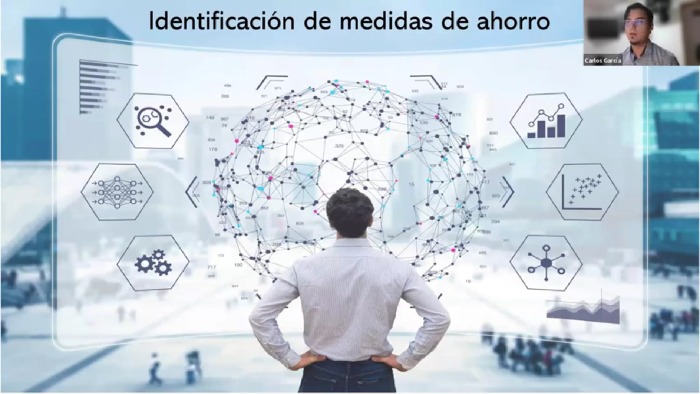
However, Carlos indicated that from the great variety of data that can be collected from the processes carried out by the air conditioning and refrigeration systems, there is a way to identify the saving measures. "The name of this way is the technical/operational, which takes up the experience that the process has, supported by data analytics, which quantifies how accurate the analysis that is carried out is, through statistical metrics and graphic representations."
To which he added, that although "it is relevant to take into account that the expertise of people is an extremely valuable input when identifying savings opportunities. Given the growing demand for information and the exponential growth of it, we cannot afford to wait for a person to learn for 5 or 6 years a process so that they master it well. That's where machine learning techniques come in, in which we give information to algorithms and they predict behaviors." That is, for Carlos the ideal is the support between Machine Learning and human experience.
Thus, the saving measures can be classified into 3: operational, which are associated with the implementation of controls for frequency adjustments, regulation of water flow and all those changes within the daily operation; maintenance, which relates to the care of the equipment, its cleaning, alignments and change of parts; finally, there are technological measures, which refer to the change of equipment and implementation of technologies to make processes more efficient, such as variable speed drives.
After explaining these three classifications, Carlos gave several examples of the use of data analytics with a regression line as a predictive model. Of these in the operational case concluded how to identify a possible saving of up to 15%, in a specific case of an HVAC system, where the ultimate goal was to reduce consumption for the same cooling conditions (90 tons), taking into account the temperature at which the equipment is controlled.
In the case of maintenance, he identified a possible saving, with relations to the values of the condensation temperature, where the tendency is that if the temperature increases, an overconsumption is caused. Here the solution was to control the condensation temperature. Finally, in the identification of technological measures, Carlos explained in a graph how the increase in years of a team, in relation to the refrigeration load it processes, increases energy consumption as well, an indicator that can inform in time when to make a change, understanding the increase in operating costs.
Energy Performance Indicators (IDEn)
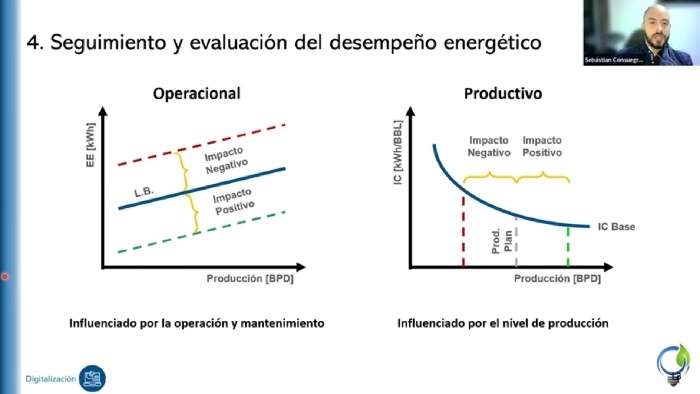
Sebastián Consuegra, data engineer and specialist in IoT solutions, indicated in his speech that, in order to achieve the identification of savings goals, energy performance indicators must be taken into account, which must be appropriate for the measurement and monitoring of energy performance. "We must ensure through identifiers that the quality of the data is reliable and quantify, at the same time, that the energy performance of the process allows to demonstrate an improvement." Hence, IDEn can be classified by their operational or productive relevance.
The engineer concluded that the importance of Big Data is that it delivers greater knowledge about processes, which gives greater power in decision making. In the same way, I point out that in the case of industry 4.0, the optimization of resources leads to environmental benefits, in addition to the broad economic benefits.