
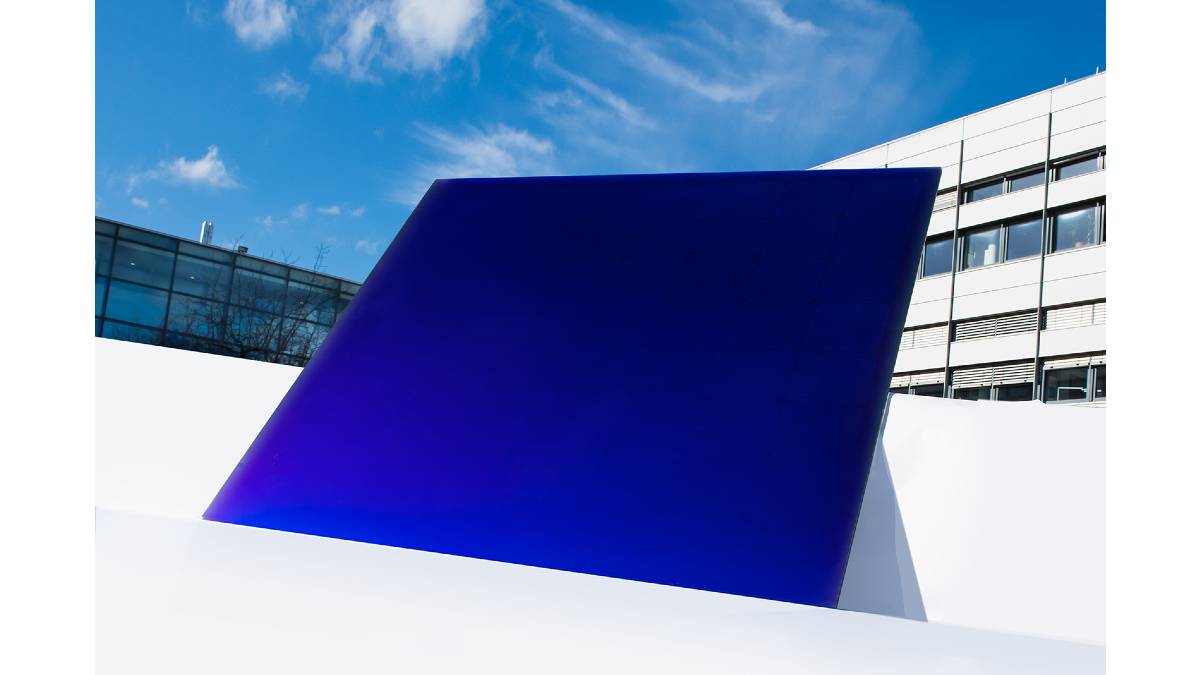
 International. Photovoltaic and solar thermal systems are not always considered aesthetically enhanced for a building. However, the color modules being developed at the Fraunhofer Institute for Solar Energy Systems ISE are challenging this perspective.
Inspired by the phenomena that provoke the bright shades of blue or green of the wings of the morpho butterfly, the underlying mechanism of spectrally selective reflectance allows the finished modules to have a uniform and homogeneous color. Whether you want beautiful bright shades or fainter grays, it is possible to design the color of the solar module to enhance or match the building in which the module will be mounted.
Generating electricity from the sun through photovoltaic systems is common today. Solar PV has become a low-cost renewable energy technology. The appearance of rooftop solar panels has also evolved with technological advances, and modern solar panels have a sleek design to maximize exterior appeal. Solar panels are manufactured by joining many (more than 60) solar cells sandwiched between a glass front sheet and a laminated polymer back sheet. As there are spaces between the solar cells, you can still see a part of the back leaf from the front. The color of the posterior sheet is traditionally white, which stands out against dark solar cells. The design of the solar panel may vary depending on the make and model. In addition to the cell type of the panel, the back sheet, frame and the presence of "busbars" can affect the final aesthetics of the installed panels. Busbars are thin strips that are welded into solar cells to collect the electricity generated by the cells.
Solar modules can be integrated almost invisibly into facades and roofs
Despite this improvement, the "look" of PV modules is still not a popular design feature among building owners and architects. Particularly when it comes to facades, which are visually more prominent than roofs. But it is important to use facades for solar modules if we want to meet the criterion of the German "energy transition", which estimates that another 2500 square kilometers of additional photovoltaic systems are required.
Therefore, researchers at the Fraunhofer Institute for Solar Energy Systems ISE in Freiburg have developed colorful and visually appealing modules. Colorful components can be manufactured in the desired color and integrated almost invisibly into facades or ceilings. They can even give the final touch to modern buildings with ventilated curtain wall façade. "The brainwave behind this development was not to color the protective glass in the modules with pigments, but to mimic the physical effect of the butterfly wings," says Dr. Thomas Kroyer, group leader of coating technologies and systems. If the glass were coated with pigments, the modules would lose a greater part of their efficiency because the light could no longer penetrate unhindered.
Inspired by the blue morpho butterfly
The iridescent bright wing of the morpho butterfly is different. These insects, which are native to the rainforest in Central and South America, create the color impression thanks to an optical effect rather than pigments. The wings of this butterfly have an extremely fine surface texture that reflects a narrow range of specific wavelengths, that is, a certain color. Fraunhofer ISE experts apply a similar surface texture and coating to the back of the protective glass of the PV modules using vacuum technology. Depending on the manufacture of the coating, the cover can be manufactured in, for example, a blue, green or sharp red. "About 93 percent of light can penetrate this layer, and only about 7 percent is reflected to cause the color effect," explains Thomas Kroyer. The Freiburg-based Fraunhofer Research Institute named its technology MorphoColour after the bright blue morpho butterfly.
Aesthetically pleasing buildings with energy plus
MorphoColour coated protective glass, produced using vacuum technology, can be laminated to form photovoltaic modules or even used in a collector for solar heat generation. There is a real benefit here because both products can be supplied from a single production line, an advantage that should also appeal to end users. In the future, it will be possible to have photovoltaic and solar thermal modules of the same color, mounted almost invisibly side by side on the roof or on the façade. When the color is matched with the rest of the building, the result is an exterior wall with a perfectly uniform finish and a façade that supplies both electricity and heat. In that sense, the homes of the future can be more aesthetically pleasing homes of energy, supplying more energy than they consume.
New mounting method avoids unsightly gaps
Color alone does not create a visually appealing design. Fraunhofer's researchers found another solution to make PV systems more attractive: To prevent welded PV cells from shining through colored protective glass, they developed an assembly method that evokes the effect of roof tiles. The roof tiles are placed on top of each other so that the rain runs.
Similarly, solar technology researchers in Freiburg are now producing photovoltaic cells in strips that overlap a few millimeters, stitching them together to form a larger module. This creates a homogeneous overall appearance with no unsightly gaps or visible connection cables. "You can look at our MorphoColour-coated PV shingles from different angles and yet the uniform appearance remains the same."
Data Source Provider: Fraunhofer Institute.