

Improving the performance of thermal and refrigeration machines not only reduces energy consumption, but also the carbon footprint. This article explains the key concepts and their importance in the search for more responsible energy use.
By: Ernesto Sanguinetti R
Thermal efficiency
Efficiency in a thermal engine is the ratio between the energy we want to obtain from the machine (useful energy = work it delivers) and the energy consumed in its operation (energy supplied = energy absorbed). For example, in a thermal power plant to produce electrical energy, thermal efficiency refers to the proportion of heat produced by the combustion of a fossil fuel that is converted into useful energy, which is the work that a generator converts into electricity. It is generally expressed as a percentage and is calculated by dividing the amount of useful energy produced by the total amount of thermal energy supplied.
What should be the "efficiency" in a refrigeration machine is the ratio between the thermal energy that is extracted using that machine (useful energy = cooling) and the energy consumed for its operation (work consumed = energy absorbed), but since that "efficiency" can be greater than one (or greater than 100%) and the Second Law of Thermodynamics says that "heat is only transmitted from substances of higher temperature to substances at lower temperature" and it is complemented by saying "thermal machines can never reach 100% efficiency", so that is why in refrigeration machines (refrigeration, air conditioning and heat pumps) the term efficiency is not used, using instead the term Cooling Effect or more commonly Coefficient of Operation or Coefficient of Performance.
Schematically, the principles of the behavior of a thermal engine and a refrigeration machine can be observed:
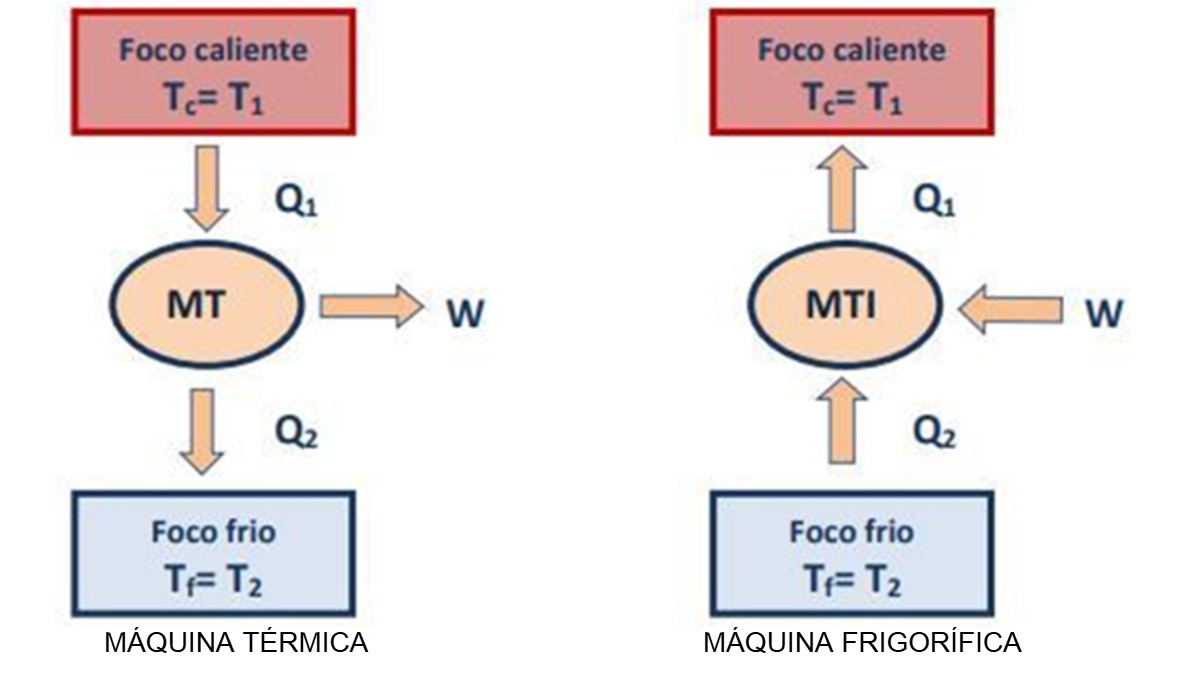
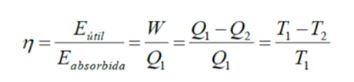
For the thermal engine, efficiency is expressed by the following ratio between the work W delivered by the machine and the heat extracted Q1 from the hot source:
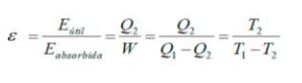
For the refrigeration machine, the cooling effect or operating coefficient is expressed by the following ratio between the heat extracted Q2 from the cold source and the work W used by the machine:
Energy efficiency
Energy efficiency is defined as the efficient use of energy. A thermal machine, a refrigeration machine, any appliance or a process or installation is energy efficient when it consumes a lower than average amount of energy to carry out the activity compared to similar machines, appliances, processes or installations.
It is the ability to obtain the best results in any activity using the least amount of energy resources possible. It promotes the search for and use of increasingly efficient equipment, which now acquires more importance because it allows reducing the consumption of any type of energy and if the electrical energy comes from Thermal Power Plants; where the heat Q1 comes from the hot source (combustion of a fuel) that always eliminates the CO2 in the "fumes"; We will be reducing "the carbon footprint" and the possible environmental impacts associated with it. Therefore, in addition to looking for equipment that needs less energy to carry out the same work, it also encourages the search to supply, totally or partially, with renewable energy sources that do not harm the environment.
We emphasize that energy efficiency seeks to protect the environment by reducing energy consumption by accustoming the user to consume what is necessary and not more. The CO2 emissions that we send into the atmosphere are increasing and their "greenhouse effect" is causing atmospheric or global warming that in the end produces climate change whose disastrous consequences we are already observing, therefore, the improvement of energy efficiency has become one of the ways to take care of our planet.
Energy indicators
In refrigeration and air conditioning equipment, the Performance Coefficient (COP) and the Energy Efficiency Ratio (EER) are still used, but as they are only indicators of the cooling effect at 100% of the capacity, they are no longer energy efficiency benchmarks, because as most equipment usually operates at partial load (because the thermal load varies most of the time), The use of variable speed drives for the motors that drive the compressors ("inverter" technology) and variable speed fans is now increasing. This "inverter technology" that increases the speed of the compressor if the heat load increases, and decreases the speed of the compressor if the heat load decreases achieves considerable energy savings.
In air conditioning, for example, it has encouraged and accelerated the use of VRV or VRF systems because with them as the desired temperature is reached, the speed of the compressor is reduced, so that to achieve the desired temperatures and maintain them, much less energy is consumed.
On the other hand, according to the variation of the seasons, the temperature of the environment varies throughout the year, therefore, due to this factor the thermal load is not constant either; that is why other Energy Indicators have been established in air conditioning equipment that also take into account these seasonal variations.
For reasons of space we will not define all of them, but we can indicate that we now have several energy indicators:
- Coef. of Operation = Coef. of Behavior = Coef. Performance = COP
- Relación de Eficiencia Energética = Energy Efficiency Ratio = EER
- Coef. of Seasonal Coefficient of Performance = SCOP.
- Relación de Eficiencia Energética Estacional = Seasonal Energy Efficiency Ratio = SEER.
- Relación de Eficiencia Energética Integrada = Integrated Energy Efficiency Ratio = IEER.
- Relación de Eficiencia Energética Combinada = Combined Energy Efficiency Ratio = CEER.
- Ratio of power consumption and cooling capacity KW/TON = Integrated Part Load Value = IPLV.
Written by: Ernesto Sanguinetti R., – Manager of the Engineering Division of COLD IMPORT S.A.- Lima – Peru.