
Fernando Cabrera, manager of FCK Ingeniería, held a conference on the impact of the façade on consumption and design in air conditioning systems, at the III International Meeting of Facades, where he explained energy modeling considering HVAC systems and energy saving.
by Iris Montoya Ricaurte
Fernando's conference had as its main objective to compare, under an energy simulation carried out in Energy Plus, different façade shading systems and the energy consumption (in Kwh) of the air conditioning system for each case.
In this space he emphasized energy simulation, which is composed of 3 pillars: modeling, calculation engine and interface. Where the engine analyzes and conceptualizes the energy consumption of all the systems involved in a building, such as the electrical or fire control system, including nearby lighting systems and HVAC, among others, taking into account international regulations. He stressed that dynamic calculations must be performed, since they are based on models that move over time and that, with their CFD-type meshing, shares the behavior of nodes around the simulation structure. Thus, this communication and correlation of data allows an energy analysis of a building, to look for the optimization parameters.
Importantly, for his model, Fernando used the Energy Plus calculation engine, the modeling by Sketch Up and the Open Studio interface.
Components of an energy modeling
However, at the conference it was indicated that an energy modeling starts from the construction model, which, in turn, begins with the geolocation of the construction, whether the case is a new or existing project. In the latter case it is important to enter the recurring consumption parameters that are held in the building, such as billing for the collection of basic services.
The next thing in the construction model is to "give name and surname" to everything that has been drawn or parameterized, because this way a detailed analysis of certain areas can be made, compared to the behavior of their spaces, especially for those that are deeper in the structure of the building. In addition, it is relevant to enter the different scenarios and behaviors, according to the type of building that you want to model, since the arrangement of its spaces and activities that are developed there will speak of the needs of air conditioning and ventilation; such is the difference between offices, food warehouses, hospitals and parking lots, to give an example.
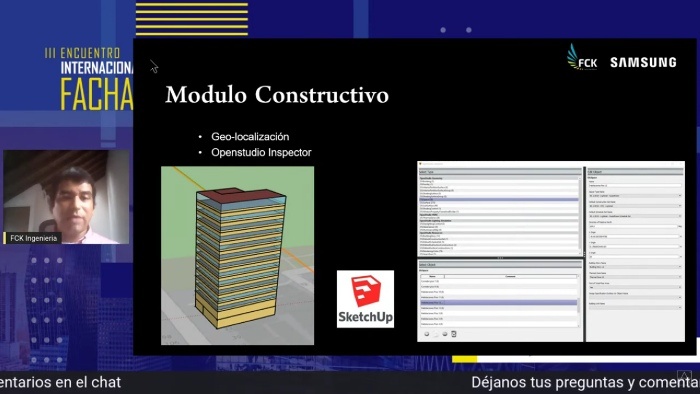
According to Fernando, these data and parameters are easily visible thanks to the Open Studio inspector, where differences in thermal zones and construction zones are noticeable. The characterization of the building is done at this stage, where the partitions, windows and spaces that compose it are distinguished in detail.
However, "the model as such is better to make it as simple as possible, because although the computing times are small, because it is a free tool there are several moments where it can collapse, due to the demand of the system. While information retrieval can be done, in some cases, when the models are very complex, it gives 'case error'."
Case Study
The example that Fernando used, for his demonstration, was a proposal from an existing hotel in the city of Bucaramanga (Colombia), which has in its general characteristics 14 floors, with a restaurant on the upper level. In addition, it has parking areas and commercial premises on the first two levels.
In your case, you uploaded weather information to EnergyPlus Weather or . EPW. The engineer commented that the climatological file has basic information, generally it should be searched from a nearby weather station, whose data help to parameterize consumption, different temperatures and humidity to which the building is exposed, which helps to understand how the structure behaves internally under the external systems that condition it. So he recommended doing this regardless of whether it is a tropical country.
Subsequently, he continued with the loading of the data from the Schedules, a set of parameters that allow to observe how the building behaves in the course of time of the climatological file. To compare the construction, in a drill as close as possible to reality, where your electrical expenses are included, for example. Then he mounted the information of the envelope as such of the building, that is, the type of façade.
Fernando noted that the Ashrae 90,1/2010 standard, which is responsible for regulating energy requirements for buildings except low-rise residential buildings, should also be taken into account. And finally, he added the average densities of the spaces (number of people, lights or equipment per square meter) to the interior of the enclosure.
Now, already entering the air conditioning systems, whose function is to consume energy to dislodge heat from the facilities, it was explained that they should be used only when passive measures are not able to manage this and the Ashrae 55 standard of comfort is broken, which indicates the acceptable thermal conditions for the human occupation of the buildings, according to a set of factors associated with the indoor environment (temperature, thermal radiation, humidity and air velocity).
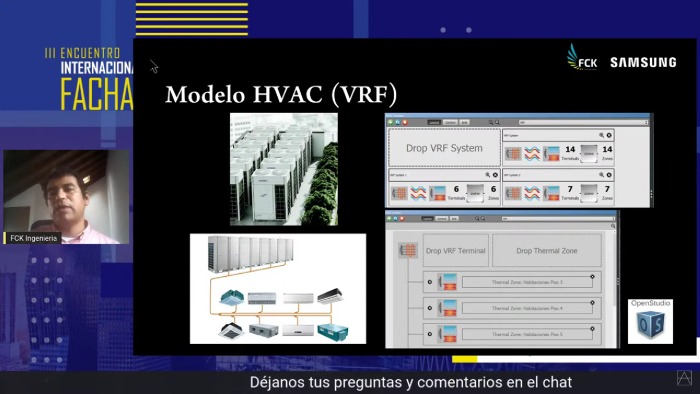
In this simulation Fernando used variable refrigerant volume (VRF) systems, which is one of the most favorable technologies for energy consumption and with LEED certifications. Which has the ability to reduce energy consumption to the minimum expression. These systems are outdoor units can be used in tandem and a series of interior units that condition the space, regardless of the architectural form of the place. Such systems can be included in the software with the Drop VRF System and the Drop VRF Terminal. The first represents the compendium of condensing units and the second the indoor units.
After uploading this information, because the idea is to see how the air conditioning system behaves before various variations of facades, a reference window wall of 0.4 was entered (in the base study), which is the recommended one. However, any variation can be applied to emulate the real construction or the design that you want to capture. Fernando indicated that this is a very extensive tool in its application and parameter details.
Finally, in the data entry, the material was parameterized and each of the shaders was entered. Taking into account the ISO 15099:2003 standard, responsible for the thermal performance of windows, doors and sun protection devices — detailed calculations.
Final comparison of results
The operation at this point is simple, once all the data is incorporated, the same program delivers the simulation. There, from the variables that can be changed, such as different HVAC systems, ailerons, modifications in the wall/window ratio, it indicates the possible energy costs that it would demand. In this case the engineer applied as variations: glazed façade (with conventional use of windows), shaded (which is characterized by elements that cover sunlight, but allow ventilation), blinded or blind façade (a much more covered model) and the surface.
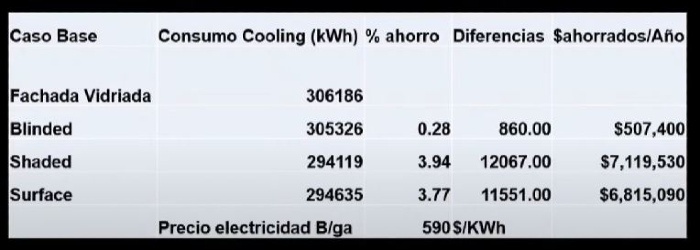
From these results, he was able to project annual expenses and savings in Kwh, which can be translated into money or reduction of CO2 emissions. The purpose of these data, in the light of the construction, modification and improvement of facades, is to establish which possibilities provide long-term improvements and are gentler with the interior comfort of the building and, therefore, with the demand for operation of air conditioning systems. In many cases the solutions that generate more savings imply a higher cost, but thanks to these simulations it is possible to explain to investors and project owners how to recover that investment in the long or medium term and which options represent a significant saving.