

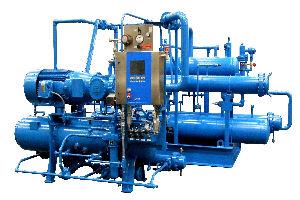
 One of the main demands of the industry has to do with energy saving and environmental conservation. Germán Robledo, from Vilter, explains the characteristics of a heat pump and the environmental and economic benefits of its use.
By: Héctor Gómez Pérez
Many industries: poultry, swine, dairy and brewery, just to mention a few examples, require hot water to carry out several of their production processes or even for cleaning inside their facilities. This hot water is obtained from a boiler using gas or any other fuel.
In this process there are many savings that these industries can perceive if they obtain hot water from the heat produced in the condenser of refrigeration systems, in this case those that use high pressure compressors or mono screw.
To understand this process, Germán Robledo, vilter's sales manager for Latin America, accepted the invitation of ACR LATINOAMÉRICA. With him we took on the task of knowing the secrets behind this way of optimizing existing resources to generate alternative processes.
The system
According to Robledo, a company that uses a gas boiler to heat water for its industrial processes can spend $523,950 a year, while if it uses a heat pump it would spend $148,050 over the same period of time. This represents a saving of US$ 375,900 per year, equivalent to 71.7% of expenses, a not insignificant figure.
But to get into the matter, it is worth remembering that a heat pump is a device that executes a cooling cycle in the opposite way, since while the cooling system removes heat, the device in question adds it.
The best known heat pumps in the industry are of the mechanical compression and absorption type; precisely the inverted cooling cycle is the best known form of mechanical compression. This inverted cycle is in the ability to heat water, glycol or other media such as oils and hydraulic fluids.
In the residential sector, these pumps are used to heat the air of heating systems and water for showers, bathrooms and kitchens. In the industrial field they are used to heat water at high temperatures or other elements that will be used for drying, germination, heating, cleaning or pasteurization.
Refrigerants
As explained by our guest, what prevails in the choice of a refrigerant for a heat pump is its critical pressure point, that is, the maximum pressure at which the refrigerant can be carried in compression. This aspect determines the use that can be given to a refrigerant, because a certain pressure corresponds in turn to a certain temperature.
"If we know the temperature we are looking for, we can determine the refrigerant or gas to be used by knowing its critical pressure. Most of them have been used freonos, but with the passage of the days others have entered such as ammonia, CO2 or water and hydrocarbons such as propane or butane. The former generate environmental problems; ammonia, for example, has toxicity problems, while third parties have flammability problems."
Although great care must be taken with its handling by toxity, ammonia is the best refrigerant thermodynamically speaking according to ASHRAE, IIAR and RETA. Precautionary measures include more qualified steel pipes and welds, which equates to a higher investment cost. "But its performance is much more efficient in Kw Vs money per ton of cooling. It also has a very high critical point which allows it to be used in heat pumps for any process, "explained Robledo and added that the only thing that has limited it is that it was not well known or there were no compressors that could handle high pressures without wearing them out or even breaking them down.
Features & Benefits
As already noted, with such a system you get energy that was thought to be wasted in the atmosphere and compress the gas in the cooling system to the point that it can heat the water according to the particular needs of each industry.
Robledo explains the above with an example in which it is necessary to have water at a temperature of 80oC in a system whose coolant is ammonia: "In this case the ammonia is compressed from 181.21 psig (196.91 psiA/13.51 bar = 35orC/95 orF) to 90oC saturation (735.4 psig/ 750.64 psiA/51.75 bar). At this value the ammonia will make the heat transfer to heat the water to 80oC and, at the same time, condense the ammonia and deliver it in liquid form at 735.4 psig which will then be expanded to return to the cooling cycle at 181.21 psig, all in a closed cycle."
Thus, although the normal cooling process is continued, the system is used for a second objective: to take advantage of the condensation heat and take it to the heat pump to start another compression cycle, but of a higher pressure.
In this way an efficient treatment is achieved, with less power consumption (HP / Kw) that satisfies the needs of cold as hot water for an industrial plant, for example, that if it did not have a heat pump it would use a certain amount of fuel and a boiler that would not only generate energy consumption and money expenditure, but problems of environmental pollution.
The Compressor and Ammonia
It had already been said that the compressor indicated for a heat pump was the screw mono, and Germán Robledo explained the reasons as follows:
"Given their internal design and geometric configuration, all axial and radial forces or stresses generated by the compression work are nullified or put into balance, making it possible for the selected bearings to have a longer service life. At the same time, the holes or communicating vessels in the rotor or screw of the compressor, put in balance both sides or sides of the screw at a single value of pressure or force, achieving that regardless of the pressure that is put in the suction is the same on the opposite side of the rotor, canceling the axial load or axial thrust, which a twin-screw or pair compressor can't achieve."
He further noted that single-screw compressors have independent slide guides, or "Paralex" system for variable capacity or variable volume (Vi) handling, which allow the exit of high-pressure gas more smoothly, as opposed to guides that are mounted on a single axis (typical of the double screw) that slow down the outlet of the high-pressure gas and generate against pressure or against flow.
Working with ammonia replaces the fossil fuel, highly polluting for the environment, which was needed to heat the water in a boiler, but also can heat media at temperatures close to 100 oC, an advantageous aspect over other refrigerants in which the temperature would reach a maximum of 50 orC.
"This is an old topic, but little developed with ammonia because before there were no suitable compressors to work with such high pressures. The continuous restrictions for freons will make ammonia take more strength and displace them, without counting the political ups and downs of oil-producing countries that constantly generate energy crises and high costs, in addition every day we look for technologies that save and use energy well. Before we had the luxury of burning gas or diesel without paying attention to the economic and environmental consequences, now we take more care of the environment and we care more about the economic impact," Robledo concluded.