
 We are again joined by the president of ACAIRE. In the following article he offers his vision about the need for a strong commitment in the industry for energy efficiency from certain improvements in equipment and the use of alternative energies.
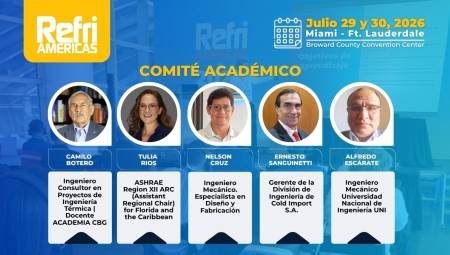
By: Camilo Botero*
The need to control atmospheric emissions of GHGs (greenhouse gases) will increasingly be based on the efficiency of environmentally sound energy systems, especially new and renewable energy sources. An important fact is that a third of the population lacks accessible commercial energy and depends on traditional sources.
Today's resources are abundant enough to meet our needs, but our energy system is unsustainable. Sustainable energy is energy produced and used in a way that supports human development in all its social, economic and environmental dimensions.
Although there appear to be no physical limits to the world's energy supply for at least the next 50 years, the current energy system is unsustainable.
If we act now we can create energy systems that lead us to a fairer, more environmentally logical and more economically viable world, says the World Energy Council.
The solution includes:
1.Promotion of energy efficiency.
2.Use of renewable energy and advanced technologies.
3.Aid to developing countries.
Oil and gas could last another 50-100 years. Coal and nuclear material resources are so abundant that they could last for centuries or millennia. 80% of primary energy consumption is based on fossil fuels. Nuclear energy contributes just over 6%, while new energies contribute only about 2%.
In search of alternatives
Renewable resources are more evenly distributed than fossil and nuclear resources, but their economic potential is affected by many obstacles.
Currently, the global capacity to convert primary energy into useful energy is about one-third. It is expected that over the next 20 years, the amount of primary energy needed can be cost-effectively reduced by 25-35% in industrialized countries. ASHRAE is promoting by 2030 the great challenge of reaching Zero Base Energy in buildings, that is, that they are autonomous in their energy generation.
Renewables have the potential to provide services with zero or near zero emissions. Pricing based on the total costs of conventional energy sources, including their impact on climate change, will make renewables more competitive.
Relevant aspects
Below I will highlight a series of issues that are of relevance with respect to the topic I have been dealing with.
Fossil energy: Technologies must be put on track towards the long-term goal of achieving almost zero emissions of pollutants and greenhouse gases without complicated end-control technologies. In places where natural gas is readily available, gas combined cycles are being chosen that offer low costs, high efficiency and low environmental impacts.
Cogeneration: It is more cost-effective and can play a better role in the economy of energy if it is based on gas turbines and combined cycles instead of steam turbines, even though these are very efficient for example in sugarcane mills, because they use their bagasse as fuel. Reciprocating engines and emerging microturbine and fuel cell technologies are also strong candidates for smaller-scale cogeneration, including commercial and residential buildings.
Synthetic: The short-term pursuit of a synthetic gas-based strategy could pave the way for widespread use of hydrogen (H2) as an energy carrier. Direct liquefaction of coal for the production of synthetic fuels.
Hydrogen: The successful development of fuel cells would facilitate the introduction ofH2 for energy. The fuel cell car will compete for the title of "car of the future" with the hybrid engine powered by internal combustion and batteries.
CO2: Recent research suggests that the global capacity for the safe removal ofCO2 in geological deposits could also be adequate to eliminate that generated by fossil fuels for hundreds of years.
Nuclear energy: It accounts for 6% of energy and 16% electricity. Most analysts predict that it will not grow, as it has great detractors for its risk and the accidents that have occurred. However, there is pressure for its use, with the aim of becoming independent of fossil fuels.
Wind energy: It has experienced a significant increase in recent years, particularly in Europe, the United States and India, being the fastest growing generation technology in recent years worldwide.
Solar energy: It is one of the alternatives with the greatest potential in the long term.
Photovoltaic cells have experienced strong growth in multiple markets in recent years, being competitive with other electricity generation mechanisms in small-scale remote installations or in special applications.
Overhead lighting: Natural lighting is increasingly important in modern buildings, not only for what it implies in energy saving, but also for its important contributions to human well-being, learning capacity and efficiency. It is necessary, therefore, the joint work of architect and engineers with the construction industry, investors in construction and owners on the use of natural lighting in the design of commercial and institutional buildings, in addition to the housing homes of tomorrow.
Available technologies
Without going into details that can be complex and very sophisticated, I will cite some technologies that contribute to optimizing air conditioning and refrigeration processes.
- High-rev compressors: With up to 33% higher performance than conventional compressors.
- Heat Pipe: Technology from aerospace research that allows the use of sensitive heat, precooling the air and reheating it at the low temperature level, to improve the relative humidity inside.
- Superheaters: These heat exchangers remove energy from the compressor discharge to the saturation zone, allowing hot water to be obtained free of charge for domestic use or in hospital facilities.
- Enthalpic wheels: They take advantage of the low temperature and humidity conditions specific to the return of the air conditioner, to precondition the outside air that comes with high temperature and high specific humidity.
- Dehumidification: There are registered equipment such as the CDQ, which provides dehumidification at low temperatures, achieving conditions that would only be reached with chemical dehumidification equipment, allowing the central systems to operate at higher temperature levels.
- Centralized control systems: These make the consumption exactly equal to the demand during partial loads of the systems. There are control systems (Hartmann Loop) that allow you to reach consumption as low as 0.3 Kw / TR, using several of the technologies described above. Others defend the central cold water system with variable flow in the primary.
- Cold beams and radientes panels: They are used for air conditioning, both in cold and hot environments, with great energy savings from air handling.
- Air supply by the floor (UFAD: Underfloor Air Distribution): With this system it is possible to air condition with air temperatures of the order of 65orF, when normally 55orF is used. With that, the central systems operate with great efficiency.
- Geothermal air conditioning: It takes advantage of the low temperature of the earth to make condensation in the cooling cycle, saving energy from air or condensation water and leaving the condenser buried with aesthetic benefits.
- Ice storage: It allows to use electrical energy when there are differential rates, to store "cold" during the hours that are not peak and use it when you have the maximum load.
- Enthalpic sensors: When the enthalpy of the outside air is low, the cooling system is turned off and this air is introduced directly to heat the environments.
- Use of condensation water from cooling towers: It is used to overheat air handling units that allow relative humidity control.
- Cogeneration and trigeneration: They increase the efficiency of thermal cycles of electric power generation from 33% to 80%. This topic was dealt with more extensively in my last article.
Like these there are many others that are being developed as energy is scarcer and more expensive. Pressures for a sustainable world have also developed inventiveness. We are changing but not as fast as we should.
Is a sustainable future possible?
Yes, but achieving this will require much greater confidence in a combination of improved energy efficiencies, renewable resources and advanced energy technologies.
* Camilo Botero is the current president of ACAIRE and president of Camilo Botero Ingenieros Consultores Ltda. He has worked as a teacher in several Colombian universities, guilds and currently in ACAIRE in diploma courses of air conditioning projects, energy efficiency in air conditioning and refrigeration, cogeneration and trigeneration, applied psychometrics, thermodynamics, fluid mechanics, heat transfer and turbomachinery.