
 We present a Case Study conducted at Le Moyne College, Syracuse, New York (USA). where a system of solar transpiration collectors was installed that use solar energy for heating and drying processes.
by Martin Misenhimer*
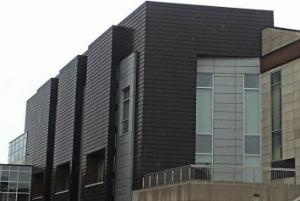
In 2008, as Le Moyne College prepared to kick off the most ambitious construction project it had undertaken on campus in its 65-year history, the university community was excited to push the boundaries of sustainability. The project consisted of a 48,000-square-foot addition to the Coyne Science Center building.
Because of New York State's climate, heating is a major expense. Design firm Ashley McGraw Architects decided to incorporate InSpire on the south side of the addition, with the dual purpose of significantly reducing the costs of heating fresh air and meeting the laboratories' rigorous ventilation requirements.
The overall appearance of the wall was also a fundamental concern, due to the building's preponderance on campus. Ashley McGraw worked closely with the manufacturer, Atas International Inc., to employ a panel that had never before been used with the InSpire wall system.
Challenge
Ashley McGraw challenged the conventional way of designing modern laboratories. "There is a tendency to miss the opportunities to use solar energy to heat the large volume of outside air required in university laboratory buildings. We wanted to show that architectural strategies do make a difference," said Matthew Broderick, head of Ashley McGraw's College and University Studio division.
Intervention
When Ashley McGraw designed the campus addition, it became clear that the project would bring new elements to the architectural repertoire, as well as a new approach to sustainability. It would also occupy a central place at the entrance of the campus, which was assumed by the design firm as an ideal canvas to make a demonstration on sustainable design.
Additionally, when the design team learned that the InSpire Wall system would be cheaper to install than a conventional masonry wall, they didn't have to think twice. The Atas multi-purpose panel was selected for its attractive appearance, giving the building a contemporary look and projecting a feel suitable for a modern science laboratory.
Results
In February 2013 the Coyne Science Center received THE GOLDEN LEED certification for the improvement in the expected energy performance, compared to the base model proposed by the ASHRAE 90.1-2007 standard.
On the other hand, the building has received two awards, one for outstanding design in the postsecondary category of the 2012 American School and University Architectural Portfolio and the other, awarded by the Central New York Chapter of the American Institute of Architects. The building was praised for its sustainable measures and design, which "harmonizes well with campus architecture, but still has a distinctive character."
New efficient technologies
Of all the energy consumed in the United States, buildings and industrial processes account for 39% and 33%, respectively. Buildings are also responsible for 30% of all greenhouse gas emissions. Consequently, year after year the interest and search for renewable energy sources have registered double-digit growth rates worldwide during the period of global economic recession. One of the technologies that will likely be quickly adopted in the energy efficiency market is solar air heating.
Scientific studies on the direct conversion of light energy into heat are widely recognized. Additionally, the technology of the solar transpiration collectors has undergone rigorous testing and boasts a proven track record of successful implementation in a wide variety of buildings.
This article explores the practical business rationale underlying the scientific concepts of energy absorption and heat transmission of solar transpiration collectors, a practical and forceful method for improving energy efficiency in all segments of the industrial and commercial sector.
What are perspiration solar collectors?
These types of collectors use perforated metal panels to preheat the outside air. That hot air is then transported into the buildings' ventilation system, thereby reducing energy consumption and supplying fresh, renewed fresh air to building occupants.
This system reduces heating costs in winter, improves indoor air quality, allows for attractive tax incentives and financial investment is quickly recouped. It can be used both in new construction and in remodeling projects, contributing to the obtaining of credits in eight (8) different categories of the LEED 2009 certification.
Solar air heating
The InSpire solar air heating system is a simple concept that uses a coating of metal plates to heat the fresh air outside. The technology easily connects to any existing heating unit to supply additional heat, whether for a building or for drying equipment. While the system does not completely replace the primary heat source, it allows for significant energy savings and an attractive return on investment.
Proceeds
The following are the main benefits of solar air heating technology:
- Less energy consumption.
- Reduction of heating costs.
- Better indoor air quality.
- Short payback period.
- Reduction of greenhouse gas emissions.
- Ideal for most industrial and agricultural applications in drying processes.
The hot air produced by the InSpire system releases the heating system from a considerable load, thus saving a significant amount of energy and money. The perspiration collector is even effective on cloudy days, albeit at a lower level.
Additionally, when this preheated fresh air system is used to heat the indoor air of a building, stratification is reduced inside industrial buildings where hot air rises to the ceiling and is usually lost through the roof or expelled with extractors. Because the indoor air in buildings is constantly being replaced, the system is ideal for mechanical workshops, machine shops, chemical storage plants and industrial applications where emissions occur. The system also creates positive pressure in the building. When you open a door or window, the heat from the inside comes out, but the cold air from the outside does not enter.
Additionally, from an environmental perspective, the system of solar transpiration collectors uses clean natural energy, which consequently reduces the need to use fossil fuels for heating, as well as the production of greenhouse gases.
Function
The InSpire panel, a solar perspiration collector, is installed a few inches from the building's external wall. The perforations allow outside air to travel across the surface of the panel. The sun-heated air found on the surface of the panel passes through the perforations, where it rises between the two walls and enters the building's central ventilation system or supply fan.
Design
Vertical and horizontal structural components are used to form passages for airflow. On the outer wall of the building are placed parts in the form of "Z", which create a chamber for the vertical displacement of air to the top of the wall.
Horizontal "U" laminated profiles are attached to the "Z" shaped parts to hold the collector panels. The depth of the separation is designed in such a way that the airflow is relatively uniform in all parts of the wall. The installation is completed by different flashings and enclosures.
Applications in buildings
This technology designed as a complete exterior wall of the building, provides heating to a wide variety of building types, including plants and production facilities, warehouses, offices and clean rooms, as well as residential and commercial constructions. In the agricultural sector, the system serves to heat barns, composting facilities, stable and sheds.
Modular applications
In addition, the technology of air breathing solar collectors is manufactured in modular units (approximate dimension = 1.5m x 3m), the hot air is channeled directly into the drying equipment. In this way, it can be used in a wide variety of applications in drying processes of products such as fruits, vegetables, nuts, spices, herbs, coconut fiber, flowers, cocoa, sugar cane, tea, grains, milk, fish, compost, manure, peat, wood building materials, wood chips, firewood, fire hoses and minerals from mining operations.
Technical information
Each square foot of the panel produces approximately 150 to 200 BTUs per hour. The honeycombs come in .032 caliber aluminum and are coated with Kynar 500 or Hylar 5000® polyvinylidene chloride® (PVDF) finishes. Thanks to its performance, this coating provides protection against disintegration or fading.
Maintenance
InSpire collector panels are virtually maintenance-free. Surface debris is naturally transported by atmospheric elements such as wind and rain. BOS (System Balance) components contain no liquids or moving parts, except for inlet fans, which require conventional maintenance.
Recognitions
The concept of the solar transpiration collector has received distinctions and awards, including the Building Operating Management Readers' Award in 2008, the Top Ten Green Building Products Award from Sustainable Industries in 2009 and the PIA Product Innovation Award in 2011, to name just a few.
* Martin Misenhimer is a business development professional, whose specialty field is renewable energy. As Atas International's sustainable building product manager, his job is to spread and create new opportunities for InSpire®, an innovative green technology that uses sunlight to produce indoor heat in commercial and industrial applications.