

 This time we will see how the control valves work through a modeling to obtain significant savings in the hydraulic air conditioning systems.
by Julio Londoño*
This time we will see how the control valves work through a modeling to obtain significant savings in the hydraulic air conditioning systems.
by Julio Londoño*
Due to the growth of LEED projects, which places a lot of emphasis on modeling the building's energy consumption profile as a key component to demonstrate savings, and the monitoring that should be given to buildings during their operation; we have begun to see some differences between what is calculated in the models and the actual behavior of these.
When building the model it is very important to know the impact that each system has on it, in addition to understanding how modeling applications calculate each behavior. One of these systems is the control valves, normally these are perceived as a passive element in the consumption profile, but in reality they have a very large impact on the energy consumption of the building directly affecting the distribution pump and on the behavior and total efficiency of the cooling plant.
That is why in the model of the building must be considered the type of valves that are going to be installed. Current modeling packages assume ideal conditions in the hydraulic system, similar to those obtained when using pressure independent valves, but if conventional valves (Pressure Dependent) are installed more arrangement with balancing valve, the model must be adjusted to model the energy losses involved in the use of this type of valves.
This article will focus on the control valves of hydraulic air conditioning systems and how they should be modeled according to the type of valve installed.
Assumptions in modeling
Most modeling packages are based on assumptions to make their calculations, although very detailed surveys are done to build the model, some of the parameters are calculated based on assumptions. Below we will look at some of the assumptions that applications use to model the hydraulic system and electrical consumption of pumps.
Assumption 1
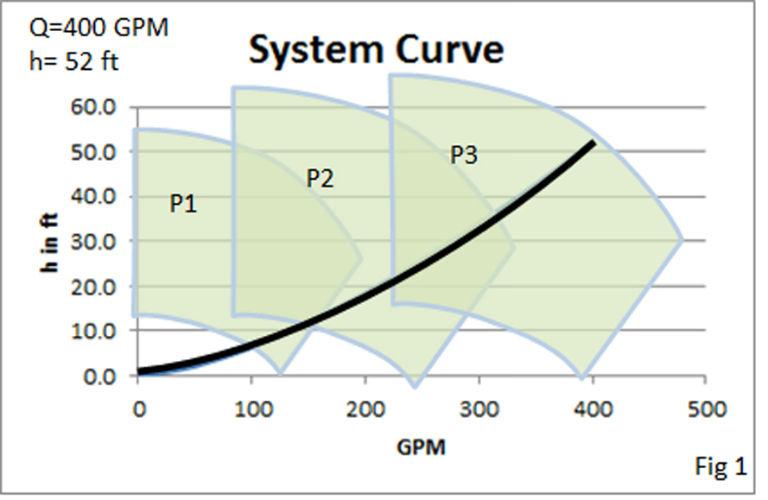
The distribution pump runs along the curve of the system: For the selection of the pump two criteria are used, the flow requirement and the total pressure drop of the system. The flow is obtained by summing the water requirements of each coil.
To obtain the pressure drop the engineer uses the longest water ring, in this way it is ensured that the farthest coil, or better yet the one that can first run out of water, has the necessary pressure to obtain the minimum water flow required. With the pressure drop information, called the pump head and given in units of length, and the flow information, given in units of volumetric flow, the curve of the system is created. The curve of the system is superimposed on the different curves of the pumps and thus the most appropriate for the application is selected.
In variable volume systems, which are controlled by measuring the differential pressure, the modeling packages make the assumption that the pump travels the curve of the system. In this way and using the law of affinity they calculate the electrical consumption of the pump for a given speed or flow.
Figure 1
But in real life this doesn't work like that; pressure losses and the pump head vary depending on the location in the system of the valves that are open. The pump head is different if the valves farthest from the pump are open and the closest ones are closed and vice versa. Instead of going through a uniform curve, the head of the pump fluctuates in an area, shown in Figure 2.
Figure 2
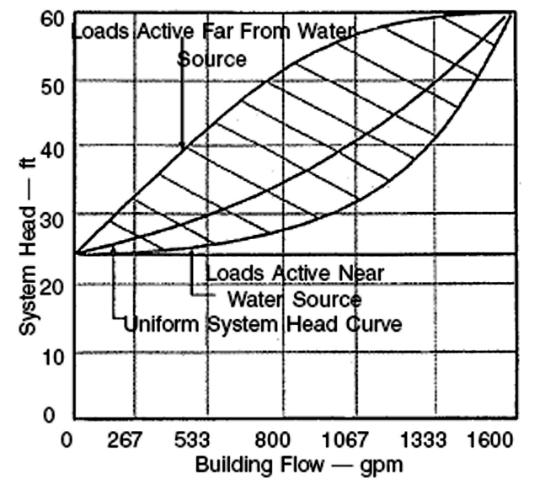 As shown in Figure 2, while modeling applications assume a uniform curve, sometimes during normal operation a larger pump head is required. These changes in the pump head expose the valves to differential pressure fluctuations outside the values for which they were selected.
The biggest benefit of pressure independent valves is always to supply a constant flow regardless of the pressure variations in the system, if these types of valves are installed, then the pressure variations will not affect the performance of the system and the modeling calculations are valid.
But, if pressure-dependent valves are installed (example: Balloon type) these pressure variations will cause the valves to lose authority and decrease their ability to perform precise control; because they have to control a flow at a higher pressure. This leads to allowing overflow of water, which is penalized in the energy consumption of the pump and in a poor heat exchange in the coil of the handler. This penalty in energy consumption is not calculated in current modeling packages.
Assumption 2
As shown in Figure 2, while modeling applications assume a uniform curve, sometimes during normal operation a larger pump head is required. These changes in the pump head expose the valves to differential pressure fluctuations outside the values for which they were selected.
The biggest benefit of pressure independent valves is always to supply a constant flow regardless of the pressure variations in the system, if these types of valves are installed, then the pressure variations will not affect the performance of the system and the modeling calculations are valid.
But, if pressure-dependent valves are installed (example: Balloon type) these pressure variations will cause the valves to lose authority and decrease their ability to perform precise control; because they have to control a flow at a higher pressure. This leads to allowing overflow of water, which is penalized in the energy consumption of the pump and in a poor heat exchange in the coil of the handler. This penalty in energy consumption is not calculated in current modeling packages.
Assumption 2
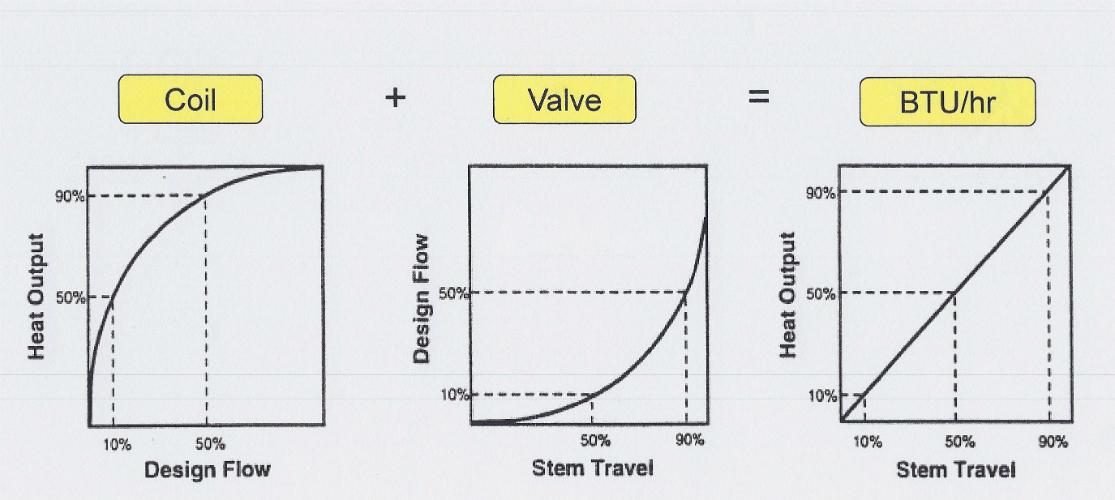
Control valves have an equiporcentual curve and are stable at partial loads: Control valves are designed with a flow characteristic that follows an equiporcentual curve assuming a constant differential pressure throughout the path of the ball or embolus if it is balloon.
This curve is controlled by the movement of the valve and is opposite to the characteristic flow curve of the coils, so that both curves are opposite and the result is a linear heat exchange.
Figure 3
 When the control valve is fully open, it supplies a specific flow for a given differential pressure (Calculation or Design Differential Pressure). It is assumed that when the valve begins to close; the flow follows the equiporcentual characteristic. It is also assumed that the pump control will be modulated to keep the design differential pressure constant through the valve.
Figure 4
When the control valve is fully open, it supplies a specific flow for a given differential pressure (Calculation or Design Differential Pressure). It is assumed that when the valve begins to close; the flow follows the equiporcentual characteristic. It is also assumed that the pump control will be modulated to keep the design differential pressure constant through the valve.
Figure 4
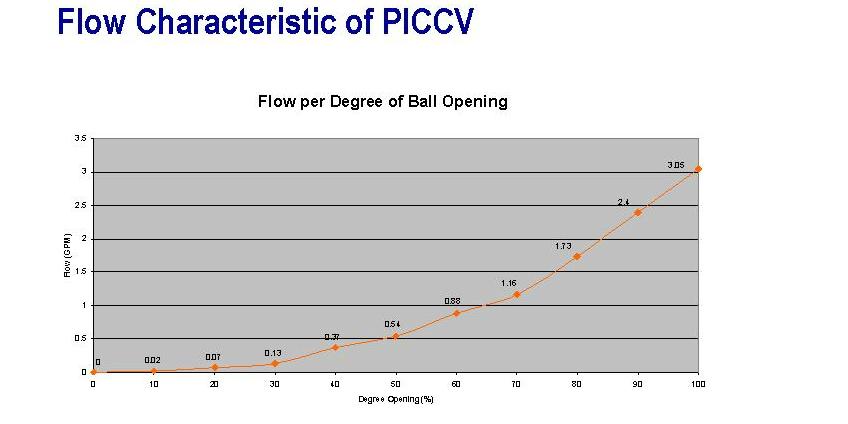 But this in real life does not happen, a variable volume system is very dynamic, although the pump control maintains the differential pressure at the point where the pressure transducer is installed, this pressure varies at other points of the system due to the constant movement of the valves.
The movement of the valves is due to changes in the load or by unstable behavior of the same. Now, when the pressure increases, the valves will let in more water than they should, Figure 5 shows the flow behavior for various valve positions when the differential pressure varies. Because of this the valve rarely supplies the exact flow given by the Flow vs. Flow curve. Position shown in Figure 4.
Figure 5
But this in real life does not happen, a variable volume system is very dynamic, although the pump control maintains the differential pressure at the point where the pressure transducer is installed, this pressure varies at other points of the system due to the constant movement of the valves.
The movement of the valves is due to changes in the load or by unstable behavior of the same. Now, when the pressure increases, the valves will let in more water than they should, Figure 5 shows the flow behavior for various valve positions when the differential pressure varies. Because of this the valve rarely supplies the exact flow given by the Flow vs. Flow curve. Position shown in Figure 4.
Figure 5
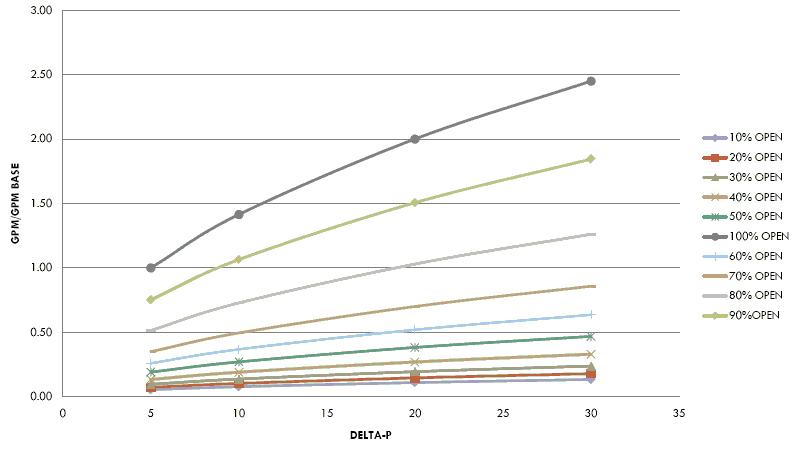
But the increase in pressure, in addition to overflow, also causes the valve to lose its initial Cv value, lose authority and become oversized. An oversized valve offers very poor control by converting a modulating valve into an on/off type.
The oscillation in the valves causes the heat transfer in the coil to deteriorate, this phenomenon is worsened at partial loads especially in those valves that are closer to the pump, because they are exposed to higher differential pressures. This is one of the main causes of low delta T syndrome.
Figure 6
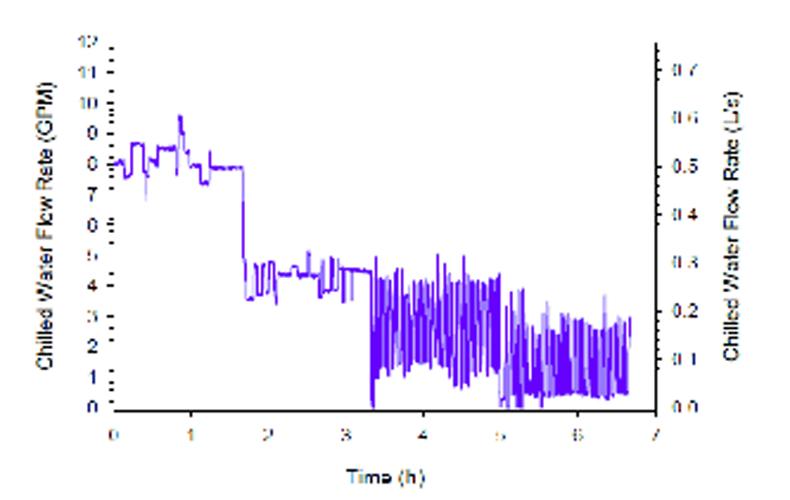 This constant oscillation of the valves makes it very difficult for the control that modulates the speed of the pump to maintain a constant differential pressure in the system and especially in each valve.
Current modeling packages, such as those developed by equipment manufacturers or those created by the U.S. Department of Energy (DOE), assume ideal hydraulic conditions similar to those obtained when installing pressure independent valves.
If this type of valves are installed, the modeling will offer results close to the real behavior of the building. But if pressure-dependent valves + balancing valves, such as Balloon-type valves, are installed, the model must be adjusted to reflect the increase in energy use in the distribution pump.
Note: in the second part of this article we will look at how to create new curves for the distribution pump.
*Julio Londoño is the Product Manager of Belimo ([email protected]).
This constant oscillation of the valves makes it very difficult for the control that modulates the speed of the pump to maintain a constant differential pressure in the system and especially in each valve.
Current modeling packages, such as those developed by equipment manufacturers or those created by the U.S. Department of Energy (DOE), assume ideal hydraulic conditions similar to those obtained when installing pressure independent valves.
If this type of valves are installed, the modeling will offer results close to the real behavior of the building. But if pressure-dependent valves + balancing valves, such as Balloon-type valves, are installed, the model must be adjusted to reflect the increase in energy use in the distribution pump.
Note: in the second part of this article we will look at how to create new curves for the distribution pump.
*Julio Londoño is the Product Manager of Belimo ([email protected]).