
 International. "The blockade will directly affect sectors that account for up to a third of GDP in major economies. For each month of containment, there will be a loss of 2 percentage points in annual GDP growth," said Angel Gurría, Secretary-General of the Organisation for Economic Co-operation and Development (OECD). The OECD estimates that the direct impact on the level of GDP from the average blockade is between 20-25% in many major advanced economies. However, the impact is not evenly distributed.
"The biggest deterioration was seen in the service sector, where companies such as airlines, restaurants, hotels, cinemas and other leisure activities were particularly affected by containment measures," states our latest report, which focuses on the Internet of Things (BIoT) market for buildings. "Closing large parts of society is not sustainable in the long run, but governments are understandably being cautious about relaxing social restrictions on the movement of people and non-essential work, which differs widely from scientific advisers."
According to the new report, Internet of Things in Smart Commercial Buildings from 2020 to 2025, the second quarter will be painful for building operators in all areas. The full picture is still evolving and will for some time, but March economic indicators, as well as early first-quarter earnings reports, paint a bleak picture of activity in the real estate sector overall. Figure 1 of the report (shown below) demonstrates the magnitude of the problem, with the impact of the blockades on national GDP over the duration of the blockade ranging from -19% to -30% in the world's major economies:
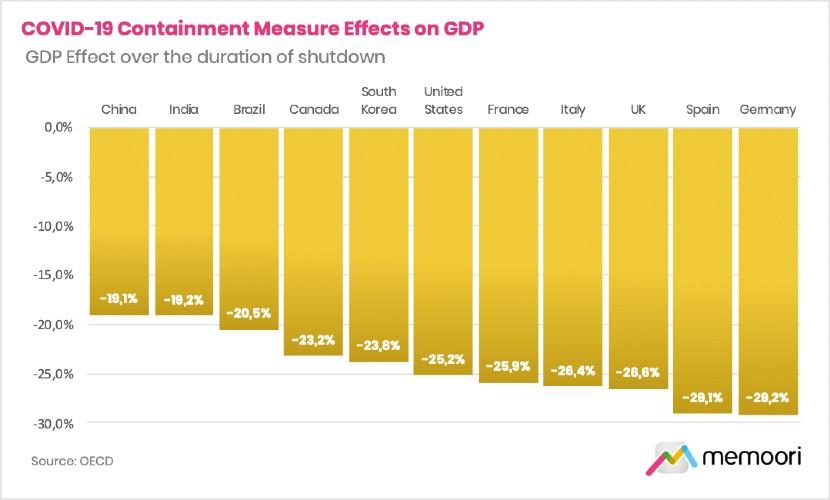
Figure 1.
However, the impact of COVID and subsequent lockdowns on real estate is not purely economic. The crisis will also change the way we use our buildings and spaces, creating unprecedented challenges in the post-COVID era. Early indicators of what a post-shutdown world of work might look like are slowly emerging as France, Italy and others begin tentatively easing their shutdown measures. This "new normal" we hear so much about seems very different, especially when it comes to commercial real estate.
Last week, Twitter announced it would allow employees the option to work from home, forever. This subsequently spread to Square Inc. and other major companies are expected to follow suit, introducing a very different "new normal" that would undoubtedly lead to a tremendous contraction of the commercial real estate market. Microsoft extended the work-from-home deadline to October 2020, while Google, Facebook and Apple have moved their dates back to the office by the end of the year. These tech giants are also major owners and will no doubt oversee the accelerating evolution of remote and flexible working trends as they make long-term decisions.
To combat this reaction to the pandemic, the BIoT has stepped up occupancy analyses to show how we could maintain social distance in buildings by tracking the movement of people. Smartphone control and hands-free interfaces, such as voice, will also see an increase in sales as buildings strive to reduce human contact with surfaces. HVAC systems ensure good air quality and try to quickly understand the role of airflow in spreading infection. And, when possible, all of these building systems will be monitored and operated remotely to reduce building occupancy. Buildings have been delayed, but technology can provide a solution if we can provide the technology.
"The COVID-19 outbreak put considerable pressure on global supply chains. Disruption of transportation, increased border restrictions, and business closures have all contributed to one of the sharp increases in supplier delivery times for many products," the new full report states. The supply of IoT technologies will undoubtedly be negatively impacted by both declines in relevant manufacturing output and supply chain disruption, but the extent to which this disruption will ultimately affect revenue will depend on the scale of the demand-side shock."
The world is disrupted and commercial real estate is in the eye of the storm: the silence of empty offices indicating that the winds of change are on the way. Recovery rates will vary significantly depending on the location, due to the local impact of COVID and government support, and depending on the vertical industry, where hospitality and aviation are the hardest hit, for example. For the proptech sector, there is light at the end of the tunnel for those with the ability to adapt and innovate.
"The delivery of all BIoT products and services will initially be adversely affected by the effects of the COVID-19 pandemic, as access to many commercial buildings remains restricted. However, IoT technologies are already being leveraged to develop effective solutions that help mitigate the negative impacts of COVID-19," our report explains.
"Some of these technologies were niche before the emergence of the virus, but now represent significant growth opportunities, others are more established but will need to adapt to meet the challenges posed by the virus," the report continues. "We are likely to see a prolonged period of innovation in the sector, with new technologies to educate, inform and ensure building users, as well as limit the spread of infection."
Source: memoori.