
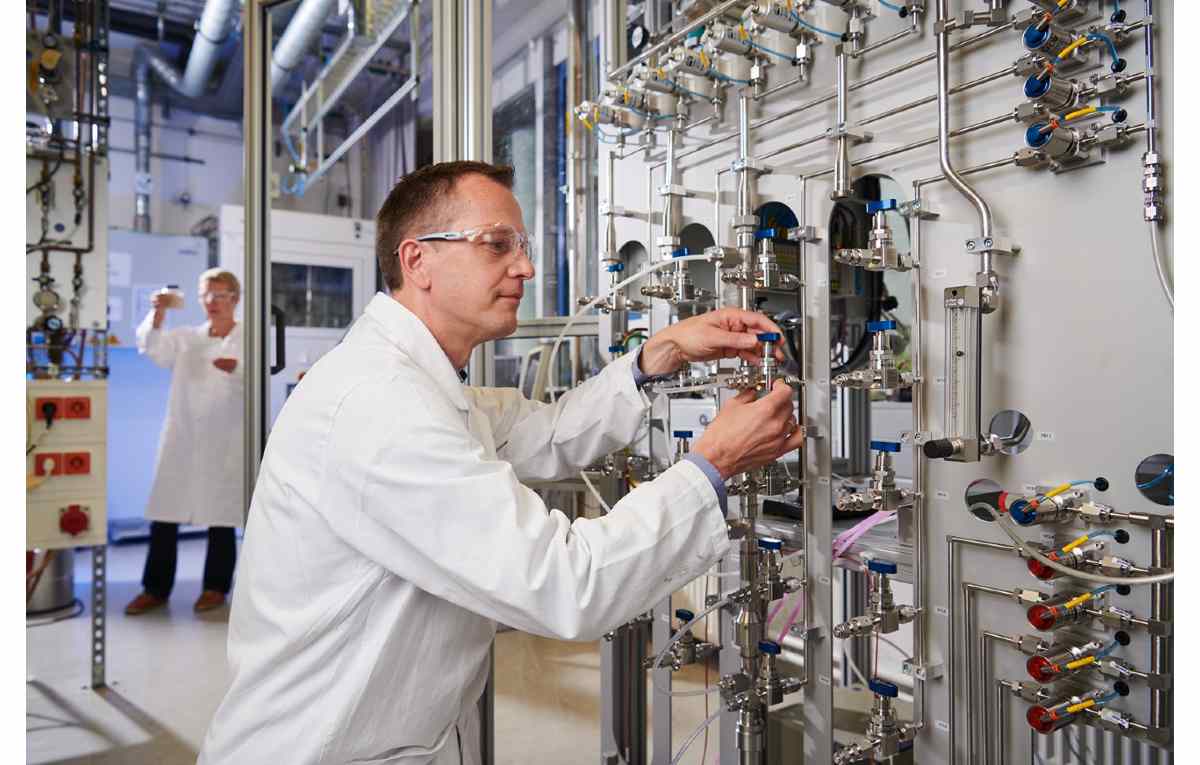
International. Laser and plasma metal processing releases many different contaminants into ambient air. The Fraunhofer Institute for Materials and Beam Technology IWS, together with its partners, has developed a filter system that efficiently removes these substances from the air. The filter can be adapted to the different materials and substances released in each case. In the future, the technology will be used in other applications, such as additive manufacturing.
When metals are processed with laser or plasma, harmful microparticles and gases, as well as substances, are released. Metallurgical companies often remove these substances from the workplace using extraction and ventilation systems. When this is not possible, employees wear protective masks.
As production becomes increasingly automated (using production robots, for example), less attention is now paid to emissions protection, because people are not permanently present at the facility. "This is a problem, because employees have to occasionally enter the facility to perform repairs and maintenance, and to monitor the quality of the products," says Jens Friedrich, Group Manager of Gas and Particulate Filtration at Fraunhofer IWS in Dresden. "In such cases, employees are not aware of how polluted the air is."
One filtering system for everything
As part of a publicly funded project, Fraunhofer IWS in Dresden developed a filter system together with companies in Saxony that cleans the air in production halls while effectively trapping a variety of pollutants. The standard today is activated carbon filter systems, which, for example, retain volatile organic compounds (VOCs). However, metallurgical companies and workshops also often release substances such as formaldehyde, nitrogen oxides and problematic sulfur compounds. Laser welding also releases microparticles of metal or welding material.
So far there has been no system available that removes all substances from the air equally well. As part of the MultiFUN project, the partners have developed such a flexible filter system for the first time. It consists of several interchangeable modules. Each filter level contains a filter media specifically designed to remove certain substances from the ambient air. In addition to activated carbon, the filter system also uses zeolites and porous polymers, for example, but also so-called metallic organic structures.
Try many different substances
To find the right filter substance, fraunhofer IWS researchers first tested a variety of substances in the lab to see how well they absorb the various air pollutants. Then, the best candidates were integrated into the prototype of the filtering system, which was
manufactured by the company ULT in Löbau. A distinctive feature of this system compared to conventional filtration systems is its monitoring sensor, which automatically detects when the filter medium is saturated with substances and needs to be replaced. The status is displayed by separately colored LEDs for each filter level and contaminant class. This means that only the filter level that is saturated should be replaced.
Importance of using filter systems
As a result of increasing automation, the number of factory rooms where air is not properly cleaned increases, such as 3D production facilities. "This is likely to lead to conflict, because nothing ever fully works without the involvement of people," says Jens Friedrich. "It is absolutely advisable to use filtering systems to protect the health of employees in the long term, even if they only enter the area from time to time." In additive manufacturing with 3D laser robots, significant amounts of microparticles are released. These are deposited and contaminate the room and workpieces. Particles can contaminate high-value products. They also pose an accident hazard, if people slip on the granules. accumulated in the soil.
Together with several companies, Fraunhofer IWS is currently working on the development of a system specifically designed to filter contaminants and substances that are released during additive manufacturing. "Our institute has experience in laser processing, in materials and in the development of complete systems," says Friedrich. "This makes us the right partner when it comes to developing these types of filtering solutions."
He also believes there is a growing need for filtration systems that remove various substances from the air in battery production and recycling. This is especially the case because metals such as nickel, manganese and cobalt are used there, which can form compounds dangerous to health even at very low doses.
The MultiFUN project was funded by the European Regional Development Fund (ERDF). Its partners include ULT AG of Löbau, SEMPA SYSTEMS GmbH of Dresden, textile manufacturer Norafin Industries GmbH of Mildenau and Fraunhofer IWS.
Source: Fraunhofer IWS.